TRM-Raft: A Byzantine-Resistant Raft Consensus via Integrated Trust and Reputation Model
Published: 2026-06-01 · Last modified: 2026-06-18
arXiv: 2607.08666
Blockchain Reputation-based Motivation Raft Consensus Signature Forgery Attack
Projects: 62332005 2023YFB3107103
Links: [PDF] [DOI] [ArXiv] [Youtube]
Abstract:
Internetware envisions autonomous software entities dynamically collaborating over the open, evolving Internet. A key enabler of such systems is the Raft consensus protocol, which is widely adopted for its simplicity and high performance in distributed coordination, e.g., in service registries, cloud orchestration, and permissioned blockchains. However, Raft’s design assumes a purely crash-fault model, making it inherently vulnerable to Byzantine behaviors such as election forgery and log tampering when deployed in the hostile, dynamic Internet environment. Existing Byzantine fault-tolerant protocols incur prohibitive communication overhead and invasive architectural changes, while point-wise hardening attempts for Raft fail to provide unified, adaptive defense.
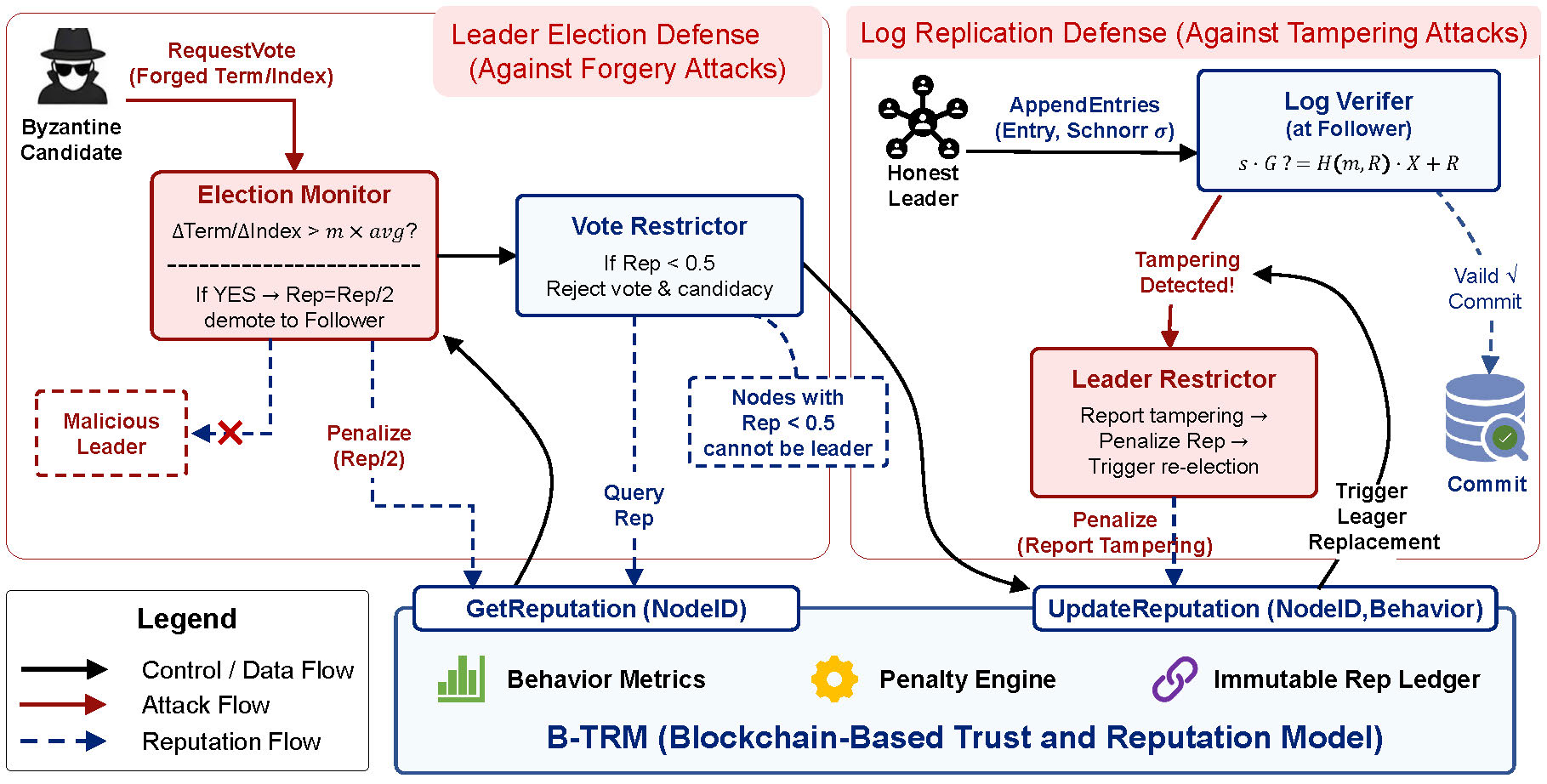
In this paper, we propose TRM-Raft, a Byzantine-resistant enhancement of Raft that non-intrusively integrates a Blockchain-based Trust and Reputation Model (B-TRM) into the consensus core. The core idea is to quantify multi-dimensional node behaviors, apply adaptive penalties that distinguish accidental faults from persistent malice, and embed reputation signals directly into leader election and log replication. Specifically, a reputation-aware election mechanism detects and harshly penalizes term/index forgery, keeping low-reputation nodes out of the leader role. A Schnorr-signature-based leader restriction mechanism enables followers to instantly verify log integrity, triggering reputation decay and leader replacement upon tampering. Implemented and evaluated in a realistic Internetware setting using Hyperledger Fabric, TRM-Raft maintains a malicious leader ratio below 5% even when 40% of nodes are Byzantine, while introducing less than 10% throughput degradation and under 5% latency increase compared to vanilla Raft. TRM-Raft thus provides a lightweight and highly usable path toward trustworthiness for the broad class of Internetware systems that rely on Raft.
BibTeX
@article{DBLP:journals/corr/abs-2607-08666,
author       = {Jie Zhang and
                Xubo Fan and
                Xiaohong Li and
                Zhiyong Feng},
title        = {TRM-Raft: {A} Byzantine-Resistant Raft Consensus via Integrated Trust
                and Reputation Model},
booktitle    = {Proceedings of the 17th International Conference on Internetware,
                Internetware 2026, Gold Coast, QLD, Australia, July 18-20, 2026},
pages        = {1--11},
publisher    = {{ACM}},
year         = {2026},
url          = {https://doi.org/10.1145/3834680.3834714},
doi          = {10.1145/3834680.3834714},
timestamp    = {Fri, 07 Aug 2026 08:52:50 +0200},
biburl       = {https://dblp.org/rec/journals/corr/abs-2607-08666.bib},
bibsource    = {dblp computer science bibliography, https://dblp.org}
}